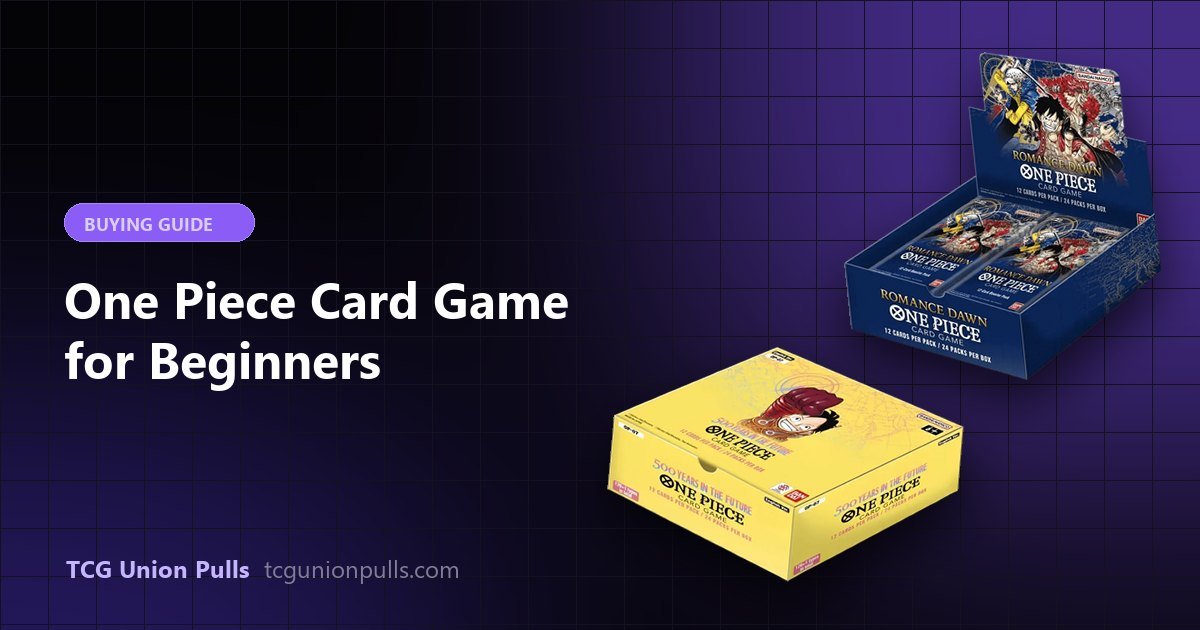
If you are searching for one piece card game for beginners advice, you are in the right place. The ONE PIECE CARD GAME from Bandai is fast, colorful and easy to pick up once the basic ideas click. This guide covers what you need to know, what to buy first, and how to grow from a first deck into a collection you enjoy.
What the One Piece Card Game is
The ONE PIECE CARD GAME is a two-player trading card game built on the Straw Hat Pirates’ world. Each player builds a deck around a central card, plays characters and events, and tries to take down the opponent’s life total before they do the same to you. Games tend to move quickly, which makes it welcoming for newcomers and for players coming over from other card games.
You can browse everything we carry in our One Piece section, from sealed product to accessories.
The core ideas in plain terms
You do not need to memorize the full rulebook to start. These are the building blocks worth knowing first:
- Leader card. Every deck is led by one Leader. It sits apart from your main deck, defines your deck’s color or colors, and usually has an ability that shapes how you play. It also sets how many life cards you begin with.
- The 50-card deck. Your main deck is built to a fixed size of 50 cards, made up of characters, events and stages that match your Leader’s color. There are also limits on how many copies of a single card you can include, so check the current rules when you build.
- DON!! cards. These are the game’s resource. They sit in their own separate deck, and you bring more into play as turns go on. You spend them to play cards and can also attach them to characters or your Leader to make them stronger.
- Life cards. Instead of a number on a counter, your life is a stack of face-down cards. When you take damage, you flip one up and it usually goes to your hand, so being hit is not always bad news.
Turn structure follows a steady rhythm: refresh your cards, draw, gain DON!!, take your main actions, then pass. Once you have played two or three games, the flow becomes second nature.
Why starter decks are the easiest way in
A starter deck is a ready-to-play deck built around a specific Leader. Everything you need is in one box, so you can start learning right away without worrying about deck construction or card shortages. The cards are chosen to work together, which means you spend your first few games learning how the game flows rather than wondering why your deck is not working.
Starter decks are also a good way to try different colors and play styles. One deck might lean toward aggressive attacks, while another prefers to grind out a longer game. If you are unsure which character or color appeals to you, picking the Leader you like most is a perfectly good reason to choose a deck. You will find our options in the Decks category.
If you have a friend who is also starting, consider buying two different starter decks and playing against each other. It is the cheapest and quickest way to see the game in action.
Building around a Leader and a color
Deckbuilding is simpler than it looks if you start from the Leader. Read its ability and ask what kind of cards it rewards. A Leader that likes small, quick characters points you toward an aggressive build, while one that rewards holding cards or defending points to a more patient plan.
Color matters because your main deck generally has to match your Leader’s colors. There are several colors in the game, and each tends to have its own identity, such as pressure, removal, card draw or board control. Do not worry about learning all of them at once. Pick one color you like, learn how it wants to play, and expand from there.
A few habits help early on:
- Start with a starter deck and play it a handful of times before changing anything.
- Swap in a few cards at a time so you can feel what each change does.
- Keep a good mix of cheap and expensive cards so you are not stuck with a hand you cannot play.
- Write down which matchups feel hard; that tells you what to improve.
When to move on to booster packs and boxes
Once you are comfortable with the rules, boosters are the natural next step. Opening booster packs lets you add new cards to your deck and try out ideas your starter did not include. Each pack contains a random assortment from a set, so you will pick up some cards you need and some you do not. Trading with friends fixes most of that.
If you plan to open a lot, or you want a wider pool to build from, a box is the more efficient route. A One Piece booster box is a sealed display of packs from a single set. Exact pack counts and contents vary by set, so check the product listing for the details. Boxes suit players who want to build several decks, share packs with a playgroup, or chase the rarer cards in a set.
A sensible order for most newcomers is: starter deck first, a few packs once you know what you want, and a box when the hobby has clearly stuck.
Play with others: Pirates Party and casual events
Card games are more fun with people. Casual events are the friendliest place to learn, because everyone is there to enjoy the game and most players happily explain a rule or suggest a better play. Our Pirates Party event page is a good example of a relaxed, community-focused way to get involved, whether you are a first-timer or a seasoned player.
When you go to a casual event, bring your deck, your DON!! cards and a few spare sleeves. Tell your opponent you are new; most people will slow down and talk through their turns. You will learn more in one evening of casual games than in a week of reading rules.
The collecting side: alternate arts and parallels
Many players come for the gameplay and stay for the artwork. Sets often include special versions of cards, commonly called alternate arts or parallels, which feature different illustrations or finishes. Which cards get these treatments, and how often they appear, varies by set, so treat them as a pleasant bonus rather than something to count on.
If you collect, protect what you pull. Sleeves keep cards clean during play, a deck box keeps your deck together in a bag, and a playmat gives you a smooth surface and a place to lay out your cards. They are small purchases that make a big difference over time.
Frequently asked questions
What do I need to start playing?
A starter deck is enough to play a full game, since it includes the Leader, a ready-built main deck and the DON!! cards you need. You will also want a second player with a deck of their own. Sleeves and a playmat are optional but useful.
Do I need to buy a booster box to get started?
No. A box is a better fit once you have learned the game and know the colors and Leaders you enjoy. Starting with a deck is cheaper and less overwhelming.
Can I mix colors in one deck?
Some Leaders use more than one color, and your deck follows whatever your Leader allows. Check the Leader card itself, and read the current rules, to see which cards you can include.
Is the One Piece Card Game hard to learn?
Most people find the basic rules approachable. The deeper strategy takes practice, but you can enjoy your first games after a short explanation.
Bottom line
The best way to start is simple: pick a Leader you like, play a starter deck, join a casual game, then add packs as your interest grows. Ready to begin? Explore our One Piece TCG selection and find your first deck.